Small Kitchen Organization
Under-Sink Organizer Fit Guide for Small Rental Kitchens
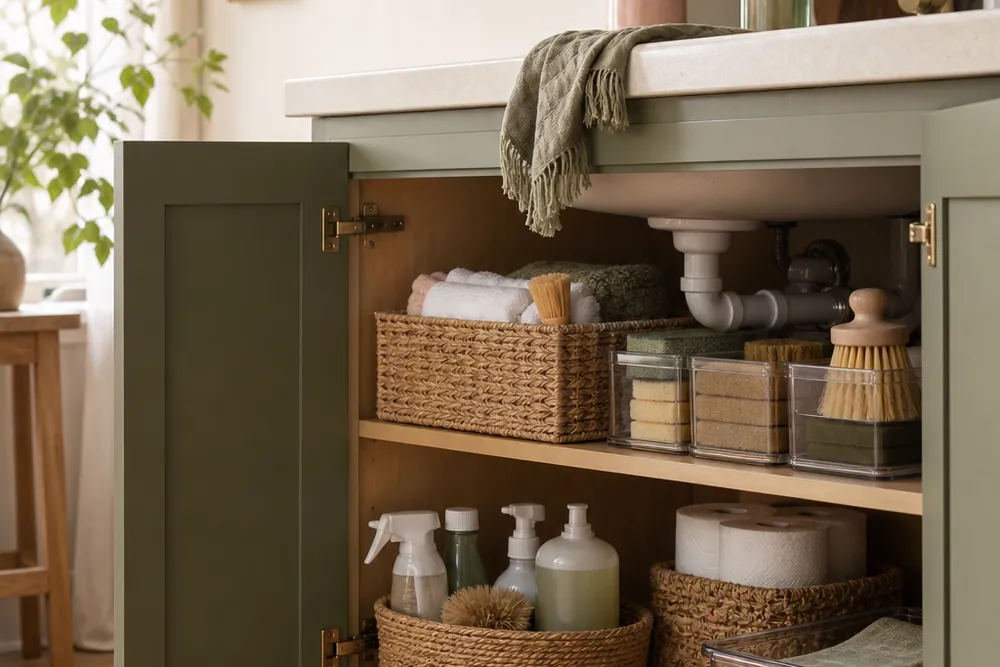
This page keeps its established URL, but the content is a selection and fit guide, not a first-person evaluation of one item. Under-sink cabinets vary too much for a universal winner: the pipe position, hinge geometry, cabinet lip and need to reach shutoff valves determine whether an expandable shelf, pull-out drawer, caddy or simple bin can work.
Affiliate pilot status: No commission-bearing links are active on this page. Candidate categories are included only as decision support; no retailer URL, product image or purchase call to action will appear without the required evidence and exact owner approval.
Do not organize over a maintenance problem. Empty the cabinet first and inspect the base, back and pipe connections. If you see active water, swelling, persistent odor or unexplained staining, stop and report the possible leak through the process in the lease. Storage can conceal a slow problem and delay detection.
Make a pipe map before shopping
Measure the door opening width, then the interior width, depth and height. Record the lowest obstruction and any front lip. With the cabinet empty, sketch a top view and mark the trap, supply lines, valves, disposal unit if present and each hinge. Measure every obstruction from a fixed edge so the sketch can be compared with an organizer diagram.
The most useful numbers are often not the cabinet’s overall dimensions. A pipe may leave a generous open area at the front but only a narrow channel at the back. A door hinge can remove the exact inch needed for a drawer rail. Photograph the tape measure in place to reduce transcription errors.
Selection guide: who each option is for—and not for
- Adjustable segmented shelves. Best for: cabinets with a flat base and plumbing concentrated in a measurable zone that shelf panels can avoid. Not for: crowded pipe layouts where posts, panels or removal would contact a service point.
- Pull-out baskets. Best for: a clear rectangular lane whose rails and loaded basket pass through the opening without striking hinges. Not for: center-divided, shallow or irregular cabinets that cannot preserve valve and leak-inspection access.
- Handled caddies. Best for: a small supply set that needs to leave the cabinet for use or maintenance. Not for: tall, dense loads that become unstable or too awkward for a comfortable one-hand lift.
Compare the main organizer types
Adjustable segmented shelf
This type uses posts and movable shelf panels to build around plumbing. It can recover vertical space when the pipes occupy a concentrated middle zone. The trade-off is assembly complexity: posts need a flat base, shelf segments need support, and the final layout may still leave awkward gaps. Verify that it can be removed without disconnecting or pushing against a pipe.
Pull-out drawer or basket
A pull-out brings supplies at the back into reach. It works best when one side of the cabinet has a clean rectangular footprint from front to back. Rails, handles and the loaded drawer must clear hinges and the opposite door. A drawer that fits inside but cannot pass through the opening is not usable.
Handled caddy
A caddy is the simplest option for a small set of supplies used in more than one room. It leaves the cabinet easier to inspect and can be removed before maintenance. Its limitation is capacity; overfilling makes tall bottles unstable and the handle hard to grip. Keep the load comfortable to lift with one hand.
Shallow open bins
Two bins can divide everyday and occasional supplies without building around every pipe. They are inexpensive to test and easy to wipe. Deep bins may hide bottles at the back, so choose a depth that can be pulled fully through the door opening.
Preserve plumbing and leak visibility
No organizer should hang from, brace against or transfer weight to plumbing. Leave enough open area to see the cabinet base and inspect connections. Shutoff valves must remain reachable; if you do not know what a component does, do not cover or alter it. Follow manufacturer guidance for the sink, disposal and organizer, and use qualified maintenance help where appropriate.
Place potentially leaky bottles upright in a washable tray or bin, but do not let a tray create false confidence. Check it during routine cleaning. Keep food, dishes and pet supplies separate from household chemicals, and follow every label for storage temperature, security and incompatibilities.
Plan access around real routines
Put the category used most often nearest the door and the heaviest safe item low. Avoid stacking containers that must be dismantled to reach one bottle. Test the largest motion: remove the tallest bottle, slide out the deepest bin and turn a valve without moving the entire system. If any step fails, reduce the footprint.
For a kitchen with few cabinets, the first-apartment kitchen setup guide can move non-cleaning categories to better zones. The storage-bin fit guide compares washable and breathable materials for the rest of the home.
Account for cabinet-specific limitations
A very shallow cabinet may not support a commercial pull-out. A center divider can prevent wide shelves from entering. A garbage disposal can create heat, vibration and an irregular footprint. Frameless and face-frame cabinets have different usable openings. In a bathroom vanity, humidity and personal-care categories change the material decision even when the plumbing looks similar.
Freestanding is renter-conscious because it avoids modifying the cabinet, but it is not automatically appropriate. Follow assembly and load limits. Add non-slip pads only when their material is compatible with the cabinet finish, and never attach a unit permanently without lease and owner approval.
Use a cardboard fit model
Cut a piece of scrap cardboard to the organizer’s footprint and slide it through the door. Mark pipe and hinge conflicts directly on it. Stack a second piece at the proposed shelf height and mimic removing bottles. This dry fit costs nothing and is more reliable than judging a styled listing photo.
After installation, load lightly and review after a week. Look behind the unit, check that the base remains dry, and confirm that no connection has been nudged. A successful system makes the cabinet easier to inspect as well as easier to use.
How we researched and edited this guide
This guide uses editorial desk research and fit analysis and is not based on product trials. We compared category-level dimensions, assembly, material, load and access requirements with common cabinet, plumbing, hinge and moisture constraints. We did not rank specific products or make price or performance claims. Any future candidate still requires exact manufacturer evidence, a real approved product URL, a rights-cleared local image and exact owner approval.
Continue with the renter storage budget plan or return to all small-space guides for the next zone.
Empty and inspect the cabinet
Remove every item, look for active moisture, swelling or staining, and report a suspected leak through the appropriate maintenance channel before adding storage.
Measure the opening and interior
Record door opening width, interior width, depth and height, plus hinge intrusion and any raised cabinet lip. The opening is often the limiting dimension.
Map every pipe and service point
Measure each pipe from the side, back and floor. Keep shutoff valves, connections and the trap visible and reachable rather than enclosing them behind bins.
Choose the access pattern
Use a removable caddy for items carried elsewhere, a shallow open bin for grouped supplies, or a pull-out unit only when its rails clear plumbing and hinges.
Check material and load
Prefer wipeable surfaces around possible drips, keep heavy containers low and follow the organizer's assembly and load instructions. Do not rest weight on plumbing.
Test and inspect
Load the organizer lightly, open both doors, remove the largest item and verify valve access. Recheck the cabinet after the first week and during routine cleaning.
Frequently asked questions
Is an expandable under-sink shelf the best option for every cabinet?
No. It can use space around pipes, but support posts and shelf segments still need a compatible footprint. A handled caddy or two shallow bins may fit an irregular cabinet better.
What should never be blocked under the sink?
Keep shutoff valves, pipe connections and the trap visible and reachable. Follow local maintenance guidance and the property manager's process if there is moisture or a leak.
Can cleaning products be stored under a kitchen sink?
Follow each label, keep products upright and separated from food, and account for children, pets, heat and possible leaks. Another secure location may be more appropriate for a particular household.